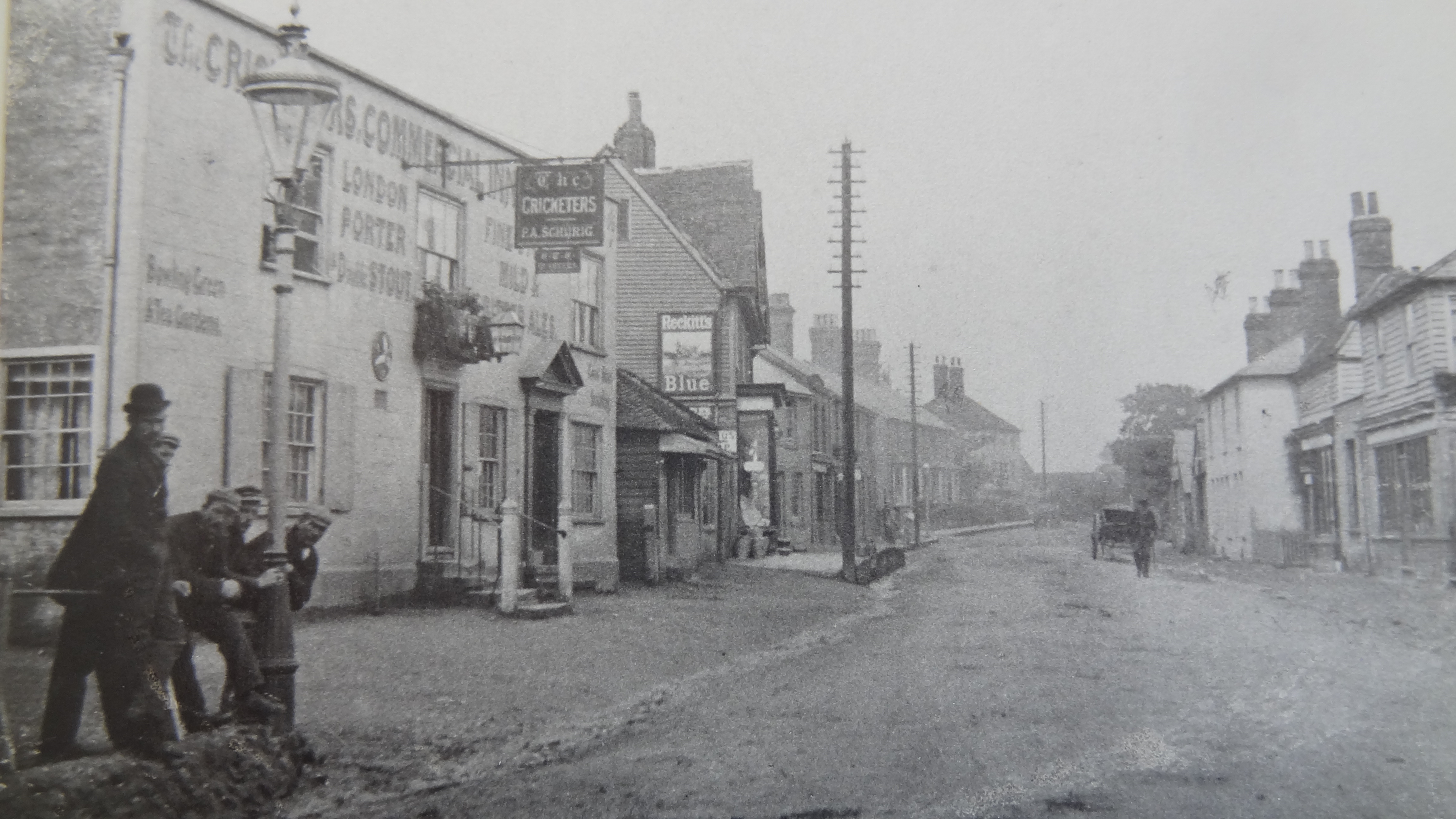
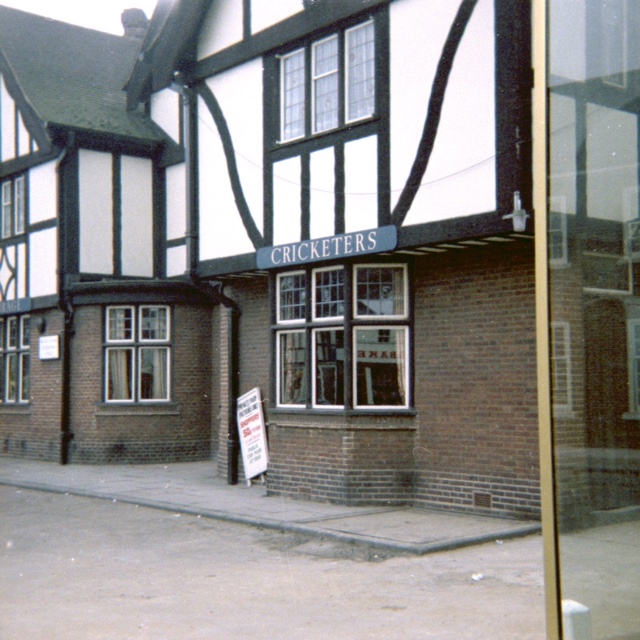
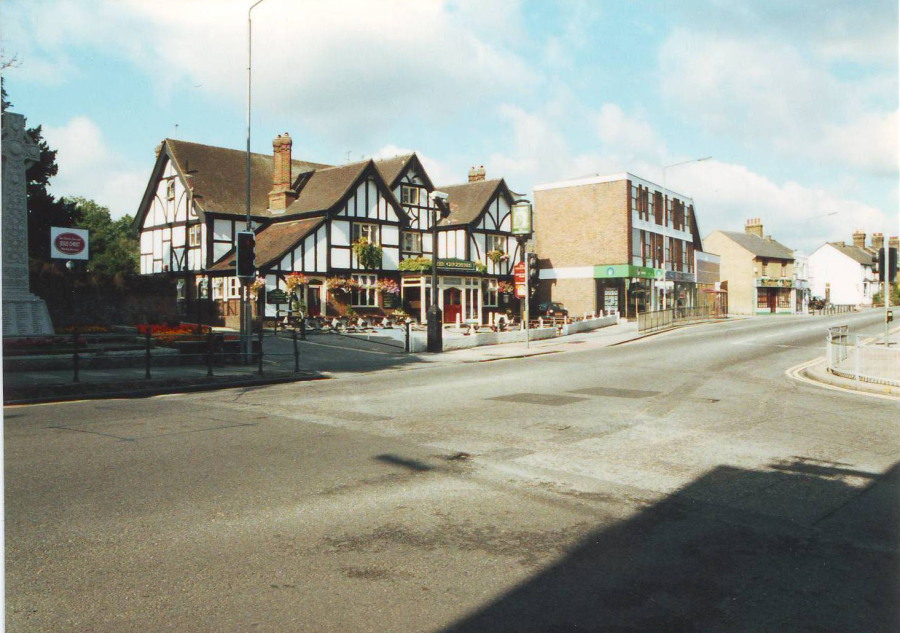
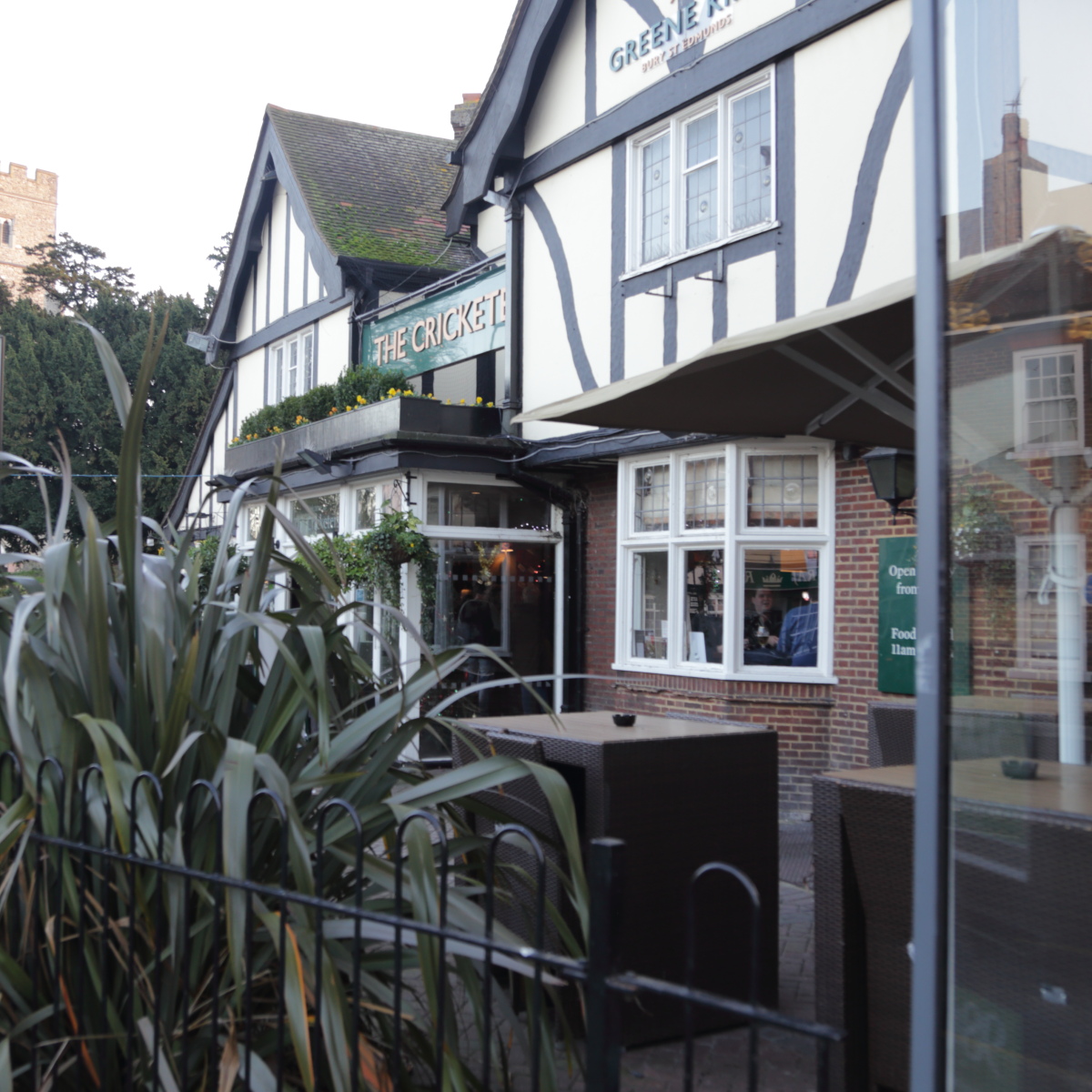
The Cricketers pub is situated in the heart of Rainham on the A2 High Street, next to the church and opposite Station Road. These photos of the Cricketers Pub in Rainham were taken in 1901, 1950, 1972, in 2001 and 2014. It was the terminus for the trams from Chatham and Rochester when they came to Rainham in 1906. The first photo is prior to the tram lines being built and was taken around 1901.
Cricketers pub in 1901. (photo thanks to Nick Knell)
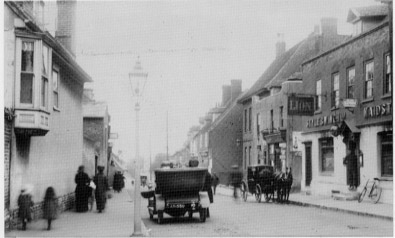
The pub sign shows P.A Schurig as the landlord at this time and the name is The Cricketers Commercial Inn. Note how the pub is much further forward than the current building, this was demolished in the 1930s and rebuilt. Another sign to the left of the pub says Bowling Green and Tea Gardens. It is advertising London Porter, Dark Stout. The shop further down the High Street is advertising Reckitts Blue.
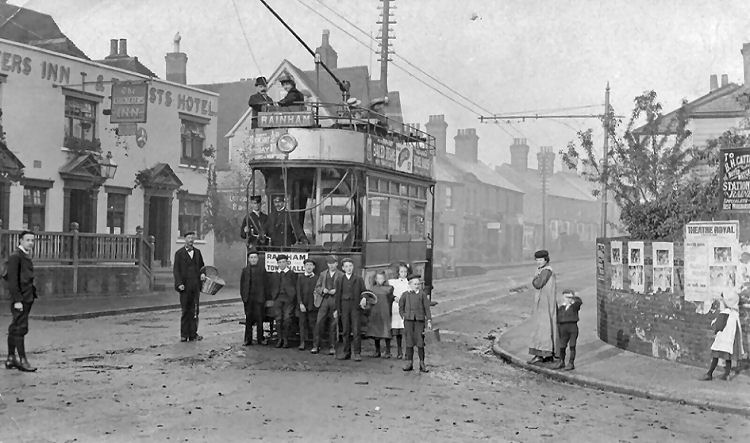
Cricketers in 1906
This photo shows the first tram to come to Rainham in 1906 outside the pub where they terminated. There are now steps and a railing outside the Cricketers which suggests the road level was slightly reduced when the tram lines were added as the door was at street level. There are now pavements on both roads of the road unlike in 1901. The pub sign has changed to read Cricketers Inn and Tourists Hotel. There is a sign for the Theatre Royal in Chatham on the wall opposite and the tram shown is from Chatham Town Hall to Rainham.
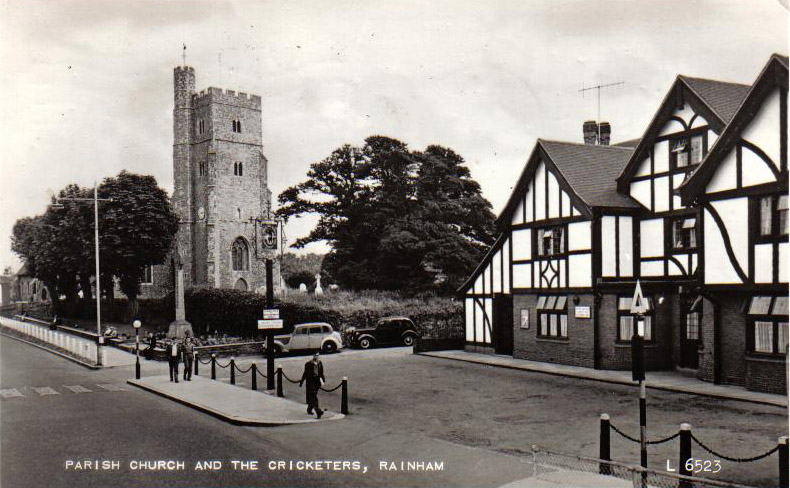
Rainham Cricketers Pub in 1950s with church in background. You can also see the belisha beacon crossing rather than traffic lights outside the pub
Cricketers Pub around 1972.
Very little changes from 1950s in this photo but the area around would have looked more different.
Cricketers Rainham in 2001
The junction is now controlled by traffic lights and there are tables to the front of the pub.
Cricketers in 2014
- Details
- Category: History Articles
Photo of the White Horse pub in Rainham in early 1900s. Read about life in Rainham in the years leading up to the First World War here

The same scene in 2013. The school to the left of the photo has been replaced by Barclays Bank and the stores of Rainham Shopping centre

- Details
- Category: History Articles
Life in Rainham during the Years Leading up to World War 1
Growing rapidly as a town on the borders of Medway and Sittingbourne, Rainham experienced a rise in population of 1,186 from 1881 to 1911. Lord Hothfield continued as Lord of the Manor and principal landowners included St Katherine’s Hospital and E. Wingfield-Stratford. Farmers in the area who owned land were Richard Mansfield Wakeley, Fred Scott and Peter Manwaring at Moor Street, Walter Stedman at Rainham Mark, William Clark in Pump Lane, Edward Filmer in Maidstone Road, James Batchelor at Cozenton Farm, J. A. Walter at Berengrave, James Stewart and Edward Randall in Bloors Lane and George Lockyer in Mierscourt. Cherries, wheat and hops were the main agricultural products while cement continued to be produced at the Cement Works in Lower Rainham.
Farmer Richard Mansfield Wakeley and Mr E Kemp of ‘Kemp Brothers’ served as Guardians of the Parish while Overseers included James Adie, Joseph Macey, Stanley Wakeley and George Bland. Meanwhile, the parish council which met on the first Wednesday of every month was chaired by Dr Henry Penfold from Mardale House and Vice-Chairman George Quinnell who lived at ‘Russells’ in the High Street. George Green from Rainham High Street served as parish clerk. The parish council had committees dealing with lighting and watching, footpaths, the recreation ground, the library and reading room and finance.
Rainham security remained the responsibility of Sergeant Edwin Jenner of Station Road and constables Thomas Fielder and William Smith. In those days a large police station didn’t exist in Rainham. Doctors Henry Penfold, Sydney Tippett and Irby Webster served as doctors in the parish.
Facilities in the town had improved compared with twenty years earlier. During the 1900s the recreation ground which had been constructed at the end of the 1880s had become established with Rainham Football Club, Rainham Cricket Club and the United Methodist Football and Cricket Clubs playing there. Rainham Fire Brigade which formed in 1901 had its headquarters on the ground with one 22 man fire engine with fire fighting equipment. A cycle track, flower beds, a shelter, a public convenience and a water pipe were also to be found. Local events like the Rainham Flower Show were held on the ground annually.
The Parish Free Library and Reading Room became established at the end of the 19th century and could be found on the ground floor of the Temperance Hotel in Station Road. With a wide choice of reading material, over 2,000 books, daily newspapers and journals were available to read. A reference library could also be found. The lending library was only open from 7 pm to 9 pm. Mr Barrell from Milton Road (now Webster Road) served as the librarian in 1908.
The construction of Rainham Social Club took place at the rear of the Temperance Hotel around 1904. Although much smaller than the present club in Station Road, it had a full sized billiard table and a membership of about seventy. Mr Child served as the steward and the club stayed open from 10 am to 10-30 pm.
The National School continued to function at the top end of Station Road for 180 boys and 160 girls. Samuel Hodson had served as headmaster since 1883 and Miss Emily Charlesworth assisted him while the infant’s school continued to be run by Mrs Brice. The Lower Rainham National School which had been erected in 1876 had about 60 pupils and was run by Miss Knight then by Mrs Seago. A small private school run by Miss Bertha Atkins also existed just off Rainham High Street near the church path.
With a rise in the local population, demand increased for another school which led to the construction of the Council School in Solomon Road in 1906. It cost the parish £4,500 to build and could hold 250 pupils. Miss E Dyason served as headmistress while Miss Ethel Barker served as infant’s headmistress. Mr Harold Greenhalgh became headmaster in March 1908 but was later killed in the Great War of 1914-1918.
A wide range of churches representing different denominations existed in various locations around central Rainham. The most prominent of these was St Margaret’s church in the high street where Reverend Charles Cobb who had served as vicar since 1876 conducted services, followed later in the decade by Reverend John Tamplin. Sunday school took place every week and a group of bell ringers also operated there.
The Providence Baptist Church which had been erected in 1884 existed in Orchard Street held about 100 people. Deacons who preached there included William Wakeley, Percy Wakeley, Alf Harnett and Mr T Roper.
The United Methodist Church stood at the junction of Station Road and Wakeley Road and could hold 250 people. Reverend J Treweeke of Henry Street served as pastor in 1908. Another United Methodist Church existed in Ivy Street with a large schoolroom at the rear and seating for about 200 people. The Providence United Methodist Church, built in 1853, existed on the Lower Road and could hold 200 people. Another religious group known as ‘The Original Peculiar People,’ an evangelical group of faith healers, had a meeting house in William Street.
The Salvation Army had its headquarters in Rainham Public Hall situated in the high street with meetings every Sunday. The army also had a ‘Band of Love’ and a junior corps. In 1908 they were led by Ensign Browne and Lieutenant Howe of Albion Terrace in Station Road.
Of the pubs in the area ‘The Lion Hotel’ run by Phil Curling became the most active and served as the headquarters for Rainham Cricket Club, Rainham Football Club, Rainham Cycle Club, Rainham & District Horticultural Society and Rainham & District Horticultural Improvement Society. Other pubs were the ‘White Horse’ run by Charles Adie, ‘The Railway’ run by Stephen Mitchell, ‘The Cricketers Inn’ run by Paul Schurig, ‘The Angel’ run by Roger Wibrew and the ‘Men of Kent’ run by John Stewart.
Many Rainham businesses like Solomon Brice & Sons clay merchant’s & barge builders, Arthur Tucker watchmaker’s, William Finness butcher’s, Edwin Jelly outfitter’s and George Whayman Draper’s dated back to the 1880s and beyond while notable new businesses included Kemp Brothers, timber merchants and smiths, Charles Clark’s outfitter’s, Miles and Kitney Mineral Water Manufacturers, Rainham & District Co-operative Society and Wilkins ironmonger’s, all located in Station Road. George Green’s Undertakers, Watt’s chemist, Walter Waters Fried Fish shop and Maria Lane’s Coffee Rooms were established in Rainham High Street. Herbert Hunt continued as the long serving sub postmaster into the twentieth century until he was succeeded by Ernest Cozens from Upchurch.
Although some changes had taken place the village had not changed a great deal for some years but the appearance of motorised vehicles which competed on the roads with horse drawn transport became more noticeable. Dr Irby Webster became the first Rainham resident to own a car in the parish.
Overall, Rainham continued to grow quickly which had been the trend since the coming of the railway during the 1850s. The village developed better facilities, encouraged new businesses and appeared to be thriving during the years leading up to World War 1.
- Details
- Category: History Articles
Richard Mansfield Wakeley Junior 1870-1943
Rainham Farmer and Cricket Legend
Born into a wealthy farming family at Moor Street Farm in Rainham in 1870 and named after his father, Richard Mansfield Wakeley entered the family farming business after leaving school. He spent his time organising the fruit and hop picking seasons in Rainham, Hartlip and Upchurch and he also had great natural ability as a cricketer.
His name first appeared as a cricketer playing for Borden School against Rainham aged thirteen at Berengrove Park on July 5th, 1883. He went on to play for Rainham Cricket Club and made his debut for Kent Second XI against Surrey at Tunbridge Wells, aged twenty-two in 1892.
Of the six Wakeley family members who played for Rainham Cricket Club during the 19th and early 20th centuries, Richard Wakeley Junior became the most successful and must rank as one of Rainham Cricket Club’s greatest ever cricketers.
Throughout the 1890s he played for Rainham whenever he could but as he was considered an exceptional player he had spells with Rochester, Mote and Chatham who played at a higher level than his home club. In 1894 he even made an appearance against the South Africans in Chatham for a Chatham & District XI. In this match which took place in order to attract top level cricket to Medway, he made scores of 0 and 21 against test match opposition.

Photo of Richard Wakeley - in the middle row wearing a cap and striped blazer.
During the late 1880s and early 1890s Richard Wakeley didn't score large quantities of runs for Rainham due to difficult and uneven wickets and long outfields. However, he still managed to come top of the club averages and was presented with a bat by the club for the best batting average in 1889. From 1892 to 1898 he only played sporadically for the club due to commitments with other clubs.
From 1898 Rainham didn’t appear to run a cricket team but when they re-formed after the Boer War in 1902 Richard Wakeley Junior became the Rainham captain and offered his meadow at Siloam Farm as the home pitch. This had been the club's original ground in 1856. Since 1890 the club had played at the recreation ground but they shared it with several other clubs and preferred more privacy.
Richard Wakeley maintained Siloam Meadow at his own expense and offered it to the club again in 1903. However, when the club held its Annual General Meeting in March 1903, members decided that the club should return to the recreation ground on the basis that it was more central. Richard Wakeley then took charge of maintaining the ground. Rainham Cricket club returned to Siloam Meadow for the 1908 and 1909 seasons after dissatisfaction with the recreation ground.
Richard Wakeley's greatest achievement at Rainham Cricket Club took place from 1902 to 1910. During this period he led the club to two consecutive Sittingbourne & District League Championships in 1905 and 1906 and helped to establish Rainham as one of the strongest cricket club’s in the area.
During the two league campaigns Rainham only suffered one defeat. This was in sharp contrast to the club's first season in league cricket in the Chatham & District League in 1896 when they lost every game and finished in bottom position. The Rainham team demonstrated its strength when it took on the area premier club Gore Court in 1906, tying the first match 88 runs each and winning the second by eight runs with Richard Wakeley scoring 80 in a total of 168. These two matches were billed 'Gore Court v The League Champions.' This was one of Rainham Cricket Club's finest periods. The East Kent Gazette reported in 1906:
‘….In R. M. Wakeley Junior they possess a captain who knows the game thoroughly, who is a first class bat and fine field, and the success of the team must be attributed to his influence and help…’
As a player Richard Wakeley Junior totally dominated the Rainham batting from 1902 and finished top of the averages every season up to 1910. He had his best season in 1907 with a batting average of 118.5. He also finished second in the Sittingbourne & District League averages in 1905 and top in 1906 with an average of 53, having scored 371 runs in eight innings. He scored at least five centuries during this period and had the honour of scoring the first recorded century for the club with 136 not out against Lower Halstow in 1904. His other batting feats included 134 not out against the Royal Marines in 1907 and 110 not out against Bobbing in 1906. In 1909 the ‘East Kent Gazette’ reported a match played between Rainham and Sittingbourne Wednesday and wrote the following about Richard Wakeley junior’s batting:
‘He received an ovation upon retiring, for he had made a gallant effort which really proved successful. To make 77 out of 111 is no everyday achievement, and it is not often that such a fine display, under such circumstances is seen in local cricket.’
Richard Wakeley Junior became a very popular and well-known captain in local cricket who had a reputation for being very astute. Known as ‘Mr Wakeley’ to the other Rainham players, he became highly respected both as a player and for the efforts he made on behalf of the club.
He got married late in life to Minnie Dundas Foulerton aged 51 in 1921 and resided at Meresborough House, close to Siloam Farm which his family owned. Like his father he played a big part in local affairs, becoming a Parish Guardian on the Milton Board of Guardians, a member of the Rainham Recreation Ground Committee, he represented Rainham on the County Council and became an alderman in 1929. He also became a school manager at the National School in Station Road and chairman of Rainham & District Horticultural Improvement Society.
Apart from being an exceptional cricketer he was also regarded a crack shot on the local shoots and rode as a regular member and follower of hounds with the Tickham Hunt in Sittingbourne like many other members of his family.
Richard Wakeley Junior stopped playing for Rainham Cricket Club at the end of the 1910 season at the age of forty to concentrate on his farm at Siloam and local politics. However, he became president of Rainham Cricket Club for a while and remained a vice-president of the club until his death in 1943. He was the last member of the Wakeley family to play cricket for Rainham.
- Details
- Category: History Articles
Photo of Rainham Cricket Club taken in 1902. Richard Wakeley is in the middle row wearing a cap and striped blazer. Immediately to his left is watchmaker Arthur Tucker whose business was based in the high street. In the back row far left is George Bland with a beard. He had a wine merchant's business in Station Road. In the back row centre is Rainham sub postmaster Herbert Hunt wearing a hat and coat. In the front row far left is Charlie Clark who had a men's outfitter's in Station Road. Next to him is Harry Robinson who lived near the Three Sisters pub and to his right is Stuart Jelly who had a men's outfitter's in the high street. The scorer is Tom Philpott who became a gardener.
- Details
- Category: History Articles
Subcategories
Historical life Article Count: 8
Historical life in Rainham
Rainham Life Article Count: 11
Rainham Life
Local Events Article Count: 52
Local Events
Photos Article Count: 167
Photos
Action Forum Article Count: 260
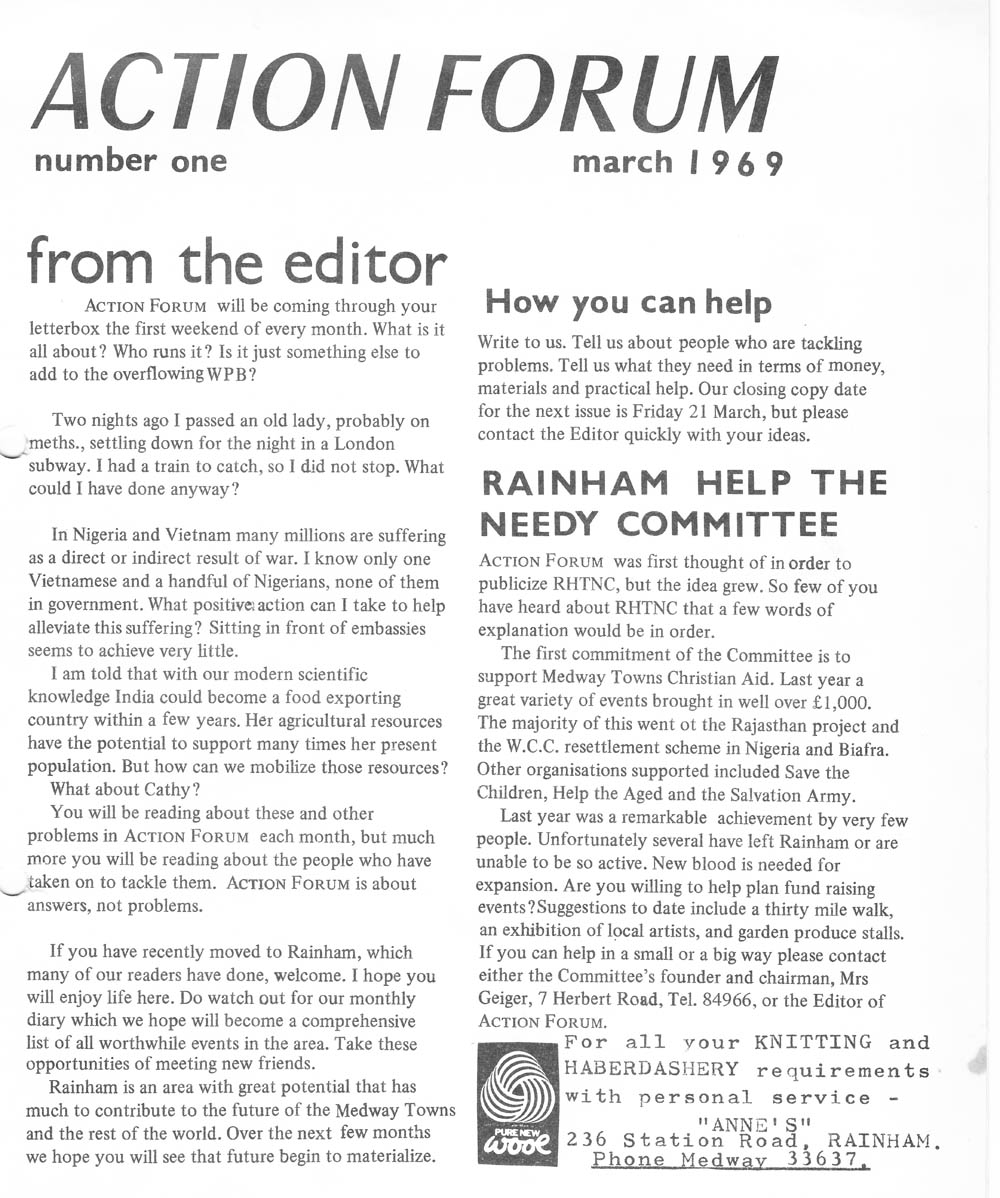
Action Forum is a free monthly magazine that is distributed to the Rainham area covering Wigmore, Parkwood and Hempstead as well. This archive covers old copies of the magazine dating back to its initial publication in 1969 and give a fascinating glimpse into life in Rainham over the last 50 years.
Link to Article Index - Action Forum Index - Photos and Articles from 1969 onwards