Christmas 1923 - Butchers Shop in Rainham
It might have been shortly after the end of the First World War but this photo shows a well stocked Rainham butcher's shop in December for Christmas 1923. This Rainham Cooperative shop in 17 Station Road Rainham Kent displays 100% English fare, home killed beef, pork, mutton, turkey, rabbit, duck and home made sausages.
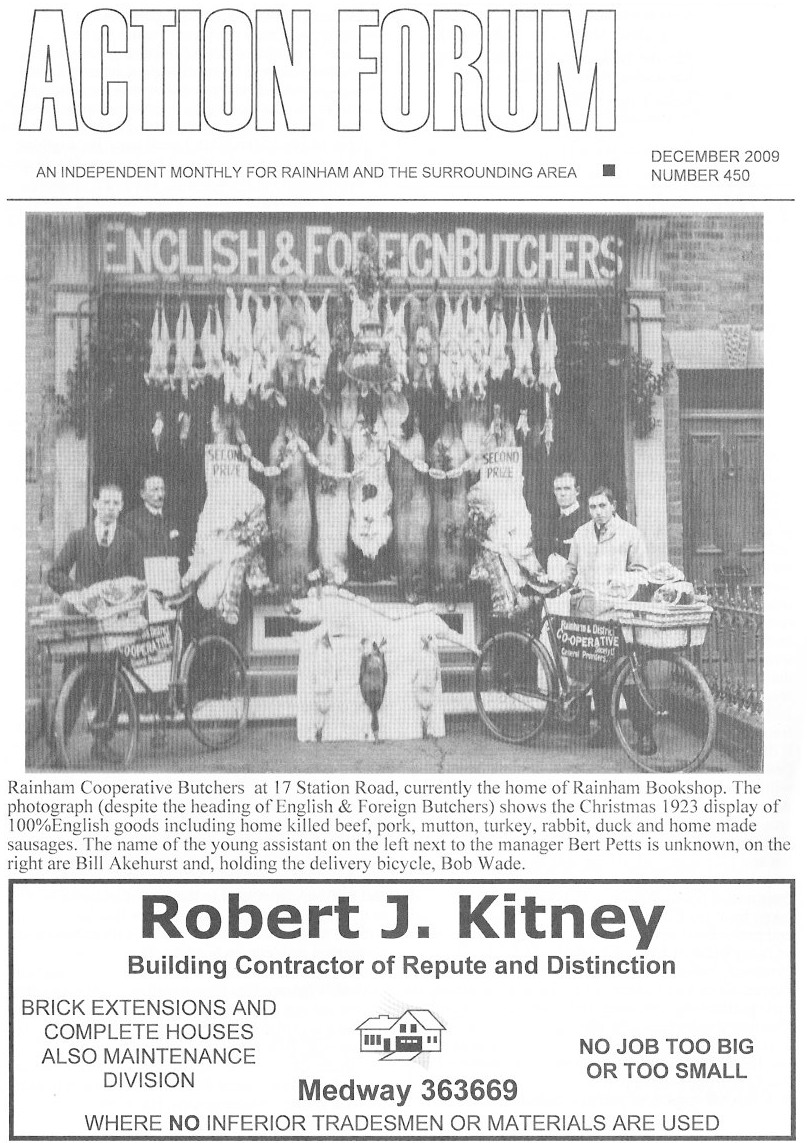
Rainham Co-operative Butchers at 17 Station Road. The photo shows the Christmas 1923 display of 100% English goods including home killed beef, pork, mutton, turkey, rabbit, duck and home made sausages.
The manager was Bert Petts, also pictured are Bill Akehurst and Bob Wade with the delivery bike.
- Details
- Category: History Articles
Reverend Charles Cobb – Real Life Hero and Long Serving Vicar of Rainham
Born in 1828 and the son of Captain Thomas Cobb of New Romney, he lived until 90 years old and became one of the oldest clergy in the country. He served as vicar of Rainham for 32 years from 1876 to 1908 and became one of the most popular and well respected clergymen to have worked the parish.
Charles Cobb entered the holy orders in 1853 after he had obtained his MA degree at Corpus Christi College, Cambridge. After this he held curacies at Halstead, St Nicholas-at-Wade, Lambeth and Minster Sheppey. In 1860 he was appointed Rector at Dymchurch where he remained for sixteen years.
While serving in Dymchurch he carried out a heroic act for which he gained widespread praise and fame. ‘The Sunday Pictorial’ dated 29th March 1936, reported that during a fierce gale on January 5th 1867 a French lugger named ‘Corrier de Dieppe’ which had been blown badly off course got wrecked on Dymchurch Sands. The coastguards tried to fire a lifeline aboard to rescue the crew but it fell short. After this three of the crew were washed into the sea and drowned but one sailor remained clinging to the rigging. A coastguard named John Batist tried to battle his way to the wreck in rough sea and strong wind but failed. Reverend Cobb, a powerful swimmer, arrived and against the wishes of some parishioners who were also present he took off his coat, dived into the sea and swam to the wreck where he reached the stranded sailor. Soon after this Batist, the coastguard, also reached the vessel and helped Reverend Cobb haul the sailor to safety.
For his act of heroism Reverend Cobb received many awards which included a gold medal from The National Lifeboat Institution in 1867 and the Albert Medal from Napoleon 111 of France. He later had a photograph of himself wearing his medals with a framed certificate from the National Lifeboat Association displayed on the wall at Rainham vicarage. John Batist who had assisted in the rescue received a bronze medal.
Later in 1876 Charles Cobb became vicar of Rainham and got fully involved in the church and local activities. During the late 1870s and early 1880s he played as a successful opening batsman for Rainham Cricket Club and also made many friends in the parish. 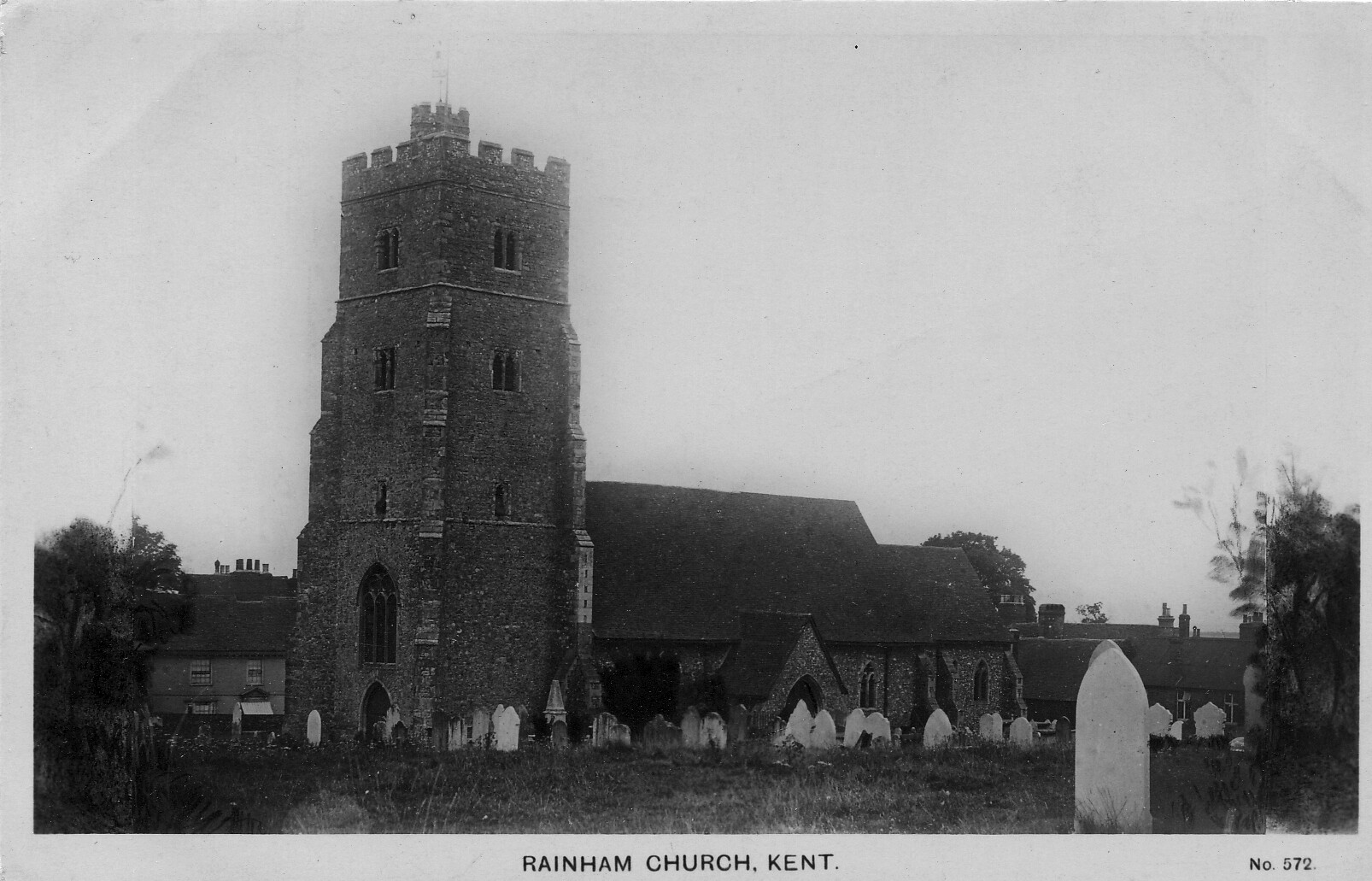
After his wife died in 1903 Reverend Cobb continued as vicar of Rainham until 1908 then resigned. Reverend Tamplin succeeded him and married his daughter. Reverend Cobb continued to reside at the vicarage and maintained a role at the church taking services when his health allowed him to do so. He regularly presided over intercession services in the church during World War 1. Held in high esteem during the time he resided in Rainham, he died in 1918 and was buried in the churchyard.
After his death the parishioners of Rainham, as a mark of respect and recognition of his services, presented the church with a new communion table and a communion plate in his memory. David Wood.
- Details
- Category: History Articles
Upchurch Pottery in Rainham
Although the pottery is named after the village of Upchurch the business started in Rainham when Seymour and Dora Wakeley who had an interest in pottery, had a bottle and kiln workshop constructed in a chalk pit just off Seymour Road on Wakeley family land. While designer Edward Spencer gave a helping hand and advice, Dora Wakeley spent her free time obtaining clay and Roman pots from the Upchurch marshes, had her designs made into her own wares and exhibited these in London at places like Crystal Palace. She described her business to the East Kent Gazette dated March 20th 1920.
“I was first interested in the potter’s art as a hobby. When I started in a very small way before the war I little dreamt that it would develop into a revived history. I enjoyed hunting round museums for designs and most of my models have been copied from Chinese and Korean wares of the 15th century. I supply Upchurch pottery to several West-End firms and as a result of this fair I have been asked to accept far more orders than I can ever hope to execute.”
At the beginning conditions for producing pottery at the workshop were basic without gas or electricity, kick wheels were used to turn the pots and water was obtained and brought to the workshop from a nearby pond. The coal fired kiln proved to be very unpredictable and the clay obtained locally. Despite these problems Upchurch pottery became well-known far and wide over time.
Potter Ted Baker who resided at Windmill Hill in Upchurch became a major reason why the pottery obtained its fame. He had originally worked with his father in the family flower pot business when he left school. He then spent some time in London where he worked in Reginald Wells’s pottery in Chelsea. Wells became a personal friend of Seymour Wakeley.
Ted Baker returned to Kent from London in 1913 and Seymour Wakeley immediately employed him as a potter at his workshop. The designs Baker worked on were mainly influenced by Greek and Roman vases and he used a style of soft colours with a matt finish. This became a characteristic of Upchurch Pottery. His glaze recipe books show that he used a large amount of boracic which intensifies colour and reduces expansion of the glaze to prevent cracking. The pottery had extraordinary and delicate colouring. The pots were fired to a great heat, up to 2,000 degrees, which caused unexpected colour effects. Dora Wakeley continued to be responsible for designs put into practice by Ted Baker, and designer Edward Spencer advised and collaborated with him with regard to glaze recipes.
During the 1920s Upchurch glazes lost popularity, described by some experts as being sombre and stolid but after 1933 the glazes became more pastel and softer. Ted Baker perfected this characteristic, and the products were exhibited at major trade fairs. His work became very popular and in demand. The pottery obtained so much fame that Queen Mary became a patron.
Due to the deterioration of the Seymour Road building the original site for the Upchurch Pottery was demolished in 1936 and Seymour Wakeley sold the business to Oscar and Grace Davies who opened the Roeginga Pottery in Rainham High Street. It only operated under them for two years but they recruited Ted Baker’s son Edward to manage it. Mrs Alice Winnecott then purchased the pottery, hired the services of Ted Baker and developed the Claverdon Range of pottery which became very popular. A thatched roof Tudor café and a pottery shop set in gardens and lawn existed close to the Man of Kent pub to attract potential customers travelling along the A2.
Although the Roeginga pottery didn’t function during World War Two it re-opened in 1948 and Ted Baker became the subject of a black and white film made at the pottery which showed the different stages of manufacture in pot making and the business did well with 200 items being produced in 1949, most of which were exported abroad.
During the summer months travellers on the way to the coast frequently stopped to watch Ted Baker at work in the pottery. After making enough money he eventually purchased the business from Mrs Winnecott in 1953. He then ran it as his own business with his two sons and they made pots for clients all over the world but in 1955 he died. Edward Baker junior then bought the business in 1956 and renamed it Rainham Pottery. After 18 more years it finally closed in 1963 mainly due to the competition of cheaper, mass produced ware and the construction of the M2 motorway which took away a lot of trade. Edward Baker continued to run the Roeginga pottery until he retired in 1975.
Today Upchurch pottery is still in demand, a style well-known in the porcelain market nationwide and is recognizable by its distinctive colouring and finishing.
- Details
- Category: History Articles
The Rainham Hero of Lucknow
At the turn of the 19th century a tall, upright and well-built man became a familiar figure on the streets of Rainham. He lived at 109 High Street, he took great pride in his appearance, people noticed that he polished his shoes every day and he wore a row of military medals on special occasions.
Born in Tarbert, County Kerry in Ireland in 1830, Cornelius Sparling joined the 81st Regiment of Foot as a twenty year old. Sent to India he completed 21 years of service on the continent and played an important part in the Indian Mutiny of 1857.
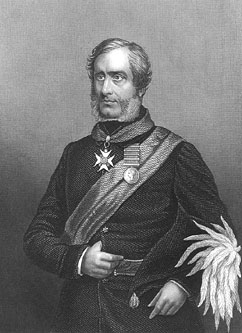 Sir Henry Havelock
Serving under Sir Henry Havelock he took part in the march on Lucknow in Uttar Pradesh where Sepoys in the army had mutinied against their British rulers because during their gun loading process they had to bite cartridges believed to be greased with pork and beef fat for their Enfield rifles which violated the religions of Muslim and Hindu troops. During the ensuing conflict Sparling rescued a regimental officer named Lieutenant Roberts who went on to become a field marshal in the British army.
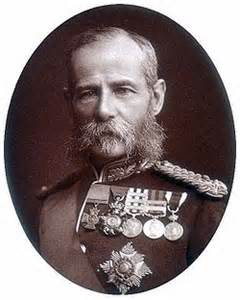
During the course of the rescue Lieutenant Roberts mounted the shoulders of Sparling and nailed the colours to the flag mast that had earlier been shot down from the British residency building. The men did this while under heavy fire from the Sepoys and they were lucky not to be killed or wounded. While the siege of Lucknow progressed Sparling could not escape until the British relief column arrived.
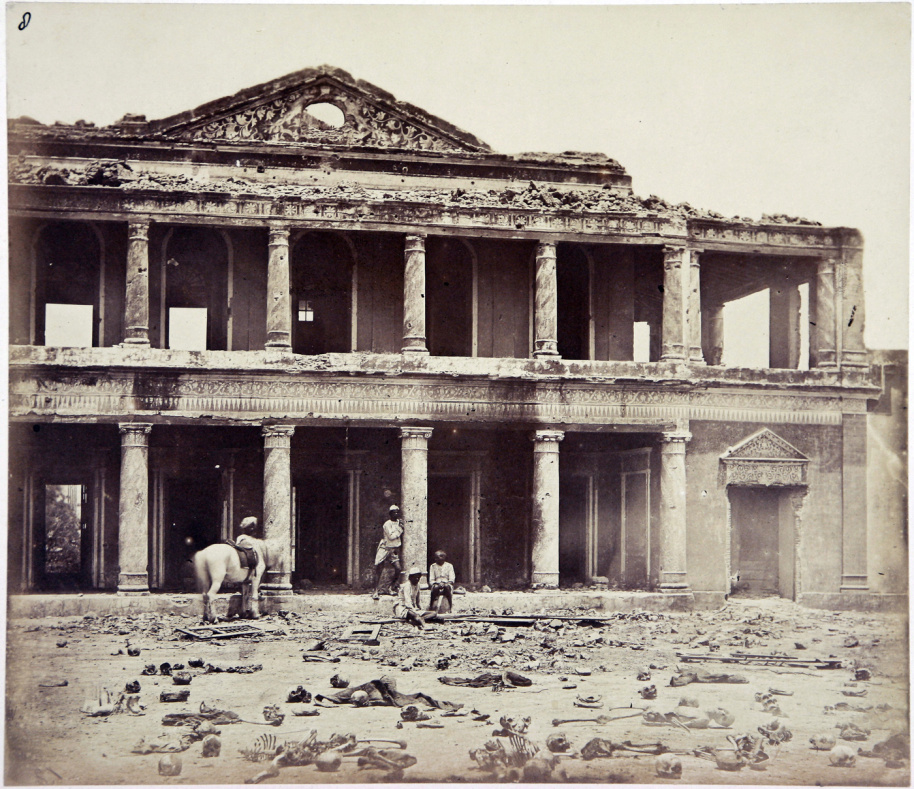 The siege and relief of the city cost the British 2,500 killed, wounded or missing. After this Sparling marched with his regiment to relieve Cawnpore which had been captured by Indian forces, but they arrived too late to prevent the massacre of 120 women and children based there. After the British had surrendered Cawnpore to the Indians in return for safe passage to Allahabad, the men were executed and the women and children hacked to death with meat cleavers and their remains thrown into a well to conceal the evidence. This led to retaliatory counter atrocities by the outraged British relief force soldiers who killed an estimated 7,000 Indian locals and executed many of the leaders of the mutiny.
After the siege and the massacre at Cawnpore Cornelius Sparling remained in India where he completed his service. As a result of his part played in the Indian Mutiny he received the Mutiny Medal with two clasps engraved ‘Lucknow’ and ‘Defence of Lucknow.’ He also received the ‘Good Conduct’ medal.
When Cornelius returned to England and lived in Gillingham former lieutenant Lord Roberts twice visited him. He then moved to Rainham where he became a familiar figure who regularly worshipped at St Margaret’s church and became a member of the Men’s Bible Class.
When Cornelius died aged 84 in 1914, 50 soldiers from Chatham accompanied by General Mullaly, Commandant of the Thames and Medway area, visited St Margaret’s church where Cornelius was given a full military funeral, the first in the village for about 30 years. With his coffin draped in the Union Jack and escorted by members of the West Kent Regiment, three volleys were fired over his grave as a final farewell to the Rainham hero of Lucknow.
- Details
- Category: History Articles
Rainham and the Aftermath of World War 1
The war had dragged on for four years but with the end of the conflict on November 11th 1918 everything slowly reverted back to normal in the village. New lighting for Rainham came under discussion at the parish council and preparations began to have a war memorial constructed to remember those who had died in the conflict while at national level the government called a General Election.
Men who had fought in the war gradually returned home, some recovering from wounds, others with stories of war experiences while a few unlucky ones were killed at the very end of the conflict. James Keutenius of Station Road died on November 10th 1918, the day before the end of the war when a German submarine torpedoed and sank the minesweeper on which he was serving. He drowned with the rest of the crew. He left three children who were orphaned as his wife had died a short time earlier. Sergeant Archie Mattocks had better luck because after being badly wounded in the face and getting a chill which developed into pneumonia he made a full recovery.
As Christmas approached influenza remained a problem in Rainham and a coal shortage took place, but food could be bought without the restrictions of the war years and rations were doubled. A Christmas turkey could be bought without coupons, eggs could be bought for 5/6d a dozen and an additional ¼ pound of sugar could be purchased while there were no restrictions on the purchase of tea.
During the Christmas period fund raising activities continued as Rainham Ladies Choir toured Rainham and Hartlip singing carols to raise funds for St Dunston’s Hostel for Blind Soldiers in Regent’s Park. Accompanied by two violinists the ladies raised £11/2/0d.
Lots of freehold properties soon became available and an auction sale took place at the White Horse pub in December 1918. Only two properties were sold and these were situated in Station Road which reflected the worsening economic situation as many people were short of money. Wakeley Brothers purchased one of the houses for £150 and the other by Mr Grout for £250. Later in the year property owners and agents raised rents in Rainham.
In early January 1919 Reverend Tamplin read out the names of 88 men known to have died in the war, a combination 64 soldiers and 24 sailors while a variety concert organised by Mrs Brewer from Sittingbourne took place in aid of a memorial for fallen Rainham soldiers and sailors.
A public meeting held in the church hall in January discussed a war memorial for Rainham. Chaired by Dr Penfold, George Quinnell from Broad Walk offered some land next to the Free Library. Other suggestions for a memorial included cottage homes, a cottage hospital, an extension to the library, baths, a public hall, a stained glass window, a memorial tablet in the church and an illuminated church clock tower. Eventually the committee decided on a monumental cross with the names of fallen Rainham men inscribed on it. The committee proposed to have it erected outside the church wall facing Station Road.
In June a public meeting took place in the Church hall to welcome about 250 returning soldiers and sailors to the parish. A decision was made to hold a dinner and concert at the Church of England school in Station Road on July 5th. About 200 men attended the event. Local MP Major Granville-Wheeler gave a speech followed by Sergeant Pack, formerly of the 9th lancers, one of the first men to arrive in France with the British Expeditionary Force in 1914 and who thanked the people of Rainham for organising and funding the event.
Peace celebrations took place in Rainham on July 19th when residents decorated the village with Chinese lanterns, flags, bunting and six decorated arches were erected at various points in the High Street and in Station Road. Voluntary subscriptions raised £125 and a committee was formed with Dr Penfold elected chairman, Mr F Mattocks became honorary secretary and Mr H Heymer treasurer. A competition for the best decorations resulted in Mr Shaw, landlord of The Cricketers Inn winning first prize.
The celebrations began at 1-45 pm with an assembly of children at the top end of Station Road headed by the band of the Chatham Salvation Army and a bugle band of the Boy Scouts. They marched to Rainham Recreation Ground where a thanksgiving service taken by Reverend Webb and Reverend F E Perry took place. A full sports event followed which included a comic cricket match between ladies and gentlemen in fancy dress and a range of sports events. Concerts, swings and amusements were also provided. Over 1,000 children sat down to tea in the afternoon. Later widows and people over 60 were served dinner at the Council School where a fete took place. Meanwhile, Mrs Brunning’s Rainham Co-operative Society Maypole party of little girls performed maypole dancing. Over 2,000 people attended the fete at the Council School and a firework display held on a piece of ground in Hamilton Avenue (later Salisbury Avenue). A torchlight procession ended the day which finished at midnight.
Over 4,000 people attended a sports day at Rainham Recreation Ground later in July. The Rainham and District Branch of the National Federation of Discharged and Demobilised Soldiers and Sailors organised this in aid of a new social club for Rainham. Over 20 events took place which included a tug of war competition and a range of cycle races which turned out to be very successful.
Frank Marchant RN from Henry Street became the first Rainham resident awarded an OBE for services rendered during the war. He had served in the Dardanelles and held the position of warrant officer at the RN barracks in Chatham. Later in the year at the church hall special constables who had patrolled Rainham during the war years were awarded illuminated certificates for their services. These were presented by Mr Payne the supervisor for special constables in the district. Not all the original constables were present as 27 had already left Rainham, four were killed in the war and five had died. Later in 1922 77 medals were presented to the special constables from Rainham and 16 from Upchurch by Lieutenant Colonel R G Locke at a special presentation in Rainham Church Hall.
Periodic meetings about the proposed war memorial took place throughout the year. By the end of May £450 had been collected and a design and estimate for a marble cross submitted. At the end of November the committee decided on and ordered a granite cross from Millen and Chrisfield of Sittingbourne for a cost of £480 with a further £20 for expenses.
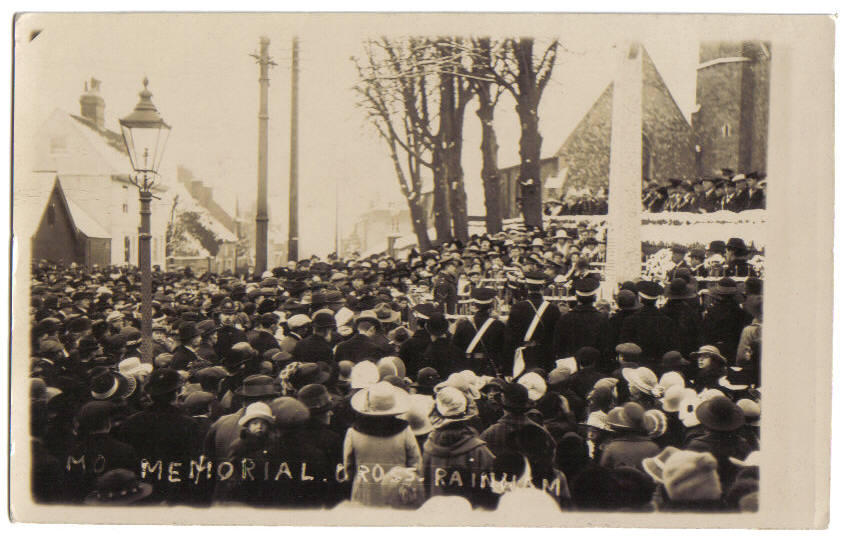
After preparation of the ground for the proposed war memorial in November, the dedication and unveiling of the monument took place on Sunday December 12th 1920. The memorial cross, a replica of the Cross of Iona from the Isle of Iona in Scotland made of Cornish granite stood 18½ feet high with 100 names of fallen Rainham servicemen inscribed on it.
The dedication service was supposed to take place outside but because of freezing conditions and snow most of it had to take place in St Margaret’s church. About 1,000 people packed into the church for the service conducted by Reverend Tamplin then Dr Penfold, chairman of the parish council, read out the names of the fallen soldiers and sailors. After this boy buglers from the Royal Engineers played the Last Post. Finally, Major-General Thuillier, General officer commanding the Thames and Medway area gave a speech.
After the service about 2,000 people gathered at the memorial and watched as Major-General Thuillier pulled the cord which caused the Union Jack enveloping the cross to fall away. Relatives placed floral tributes at the base of the memorial as they remembered the dead. Finally, the hoisting of the Union Jack from a half mast position on the church tower and the ringing of the church bells ended the event.
Rainham Congregational Church situated in Chapel Lane (now Mierscourt Road) also decided to have a war memorial in the form of a tablet placed on the church wall with names of soldiers and sailors inscribed on it. To do this they needed to raise £100 to £150 which they succeeded in doing and the tablet was placed on the church wall at a special service in August. With 15 names inscribed on a brass tablet mounted on teak wood by courtesy of the Admiralty, a special` service conducted by Reverend E Scott-Wilkinson in front of about 100 people took place on Sunday February 13th 1921 and the tablet unveiled. Silent prayers followed the unveiling and the service ended with the playing of the National Anthem.
With the ending of the war peace prevailed but a decade of high unemployment and economic downturn made life tough for many Rainham residents who found work hard to obtain and difficulty making ends meet, the price paid for a long and costly war. David Wood.
- Details
- Category: History Articles
Subcategories
Historical life Article Count: 8
Historical life in Rainham
Rainham Life Article Count: 11
Rainham Life
Local Events Article Count: 52
Local Events
Photos Article Count: 167
Photos
Action Forum Article Count: 261
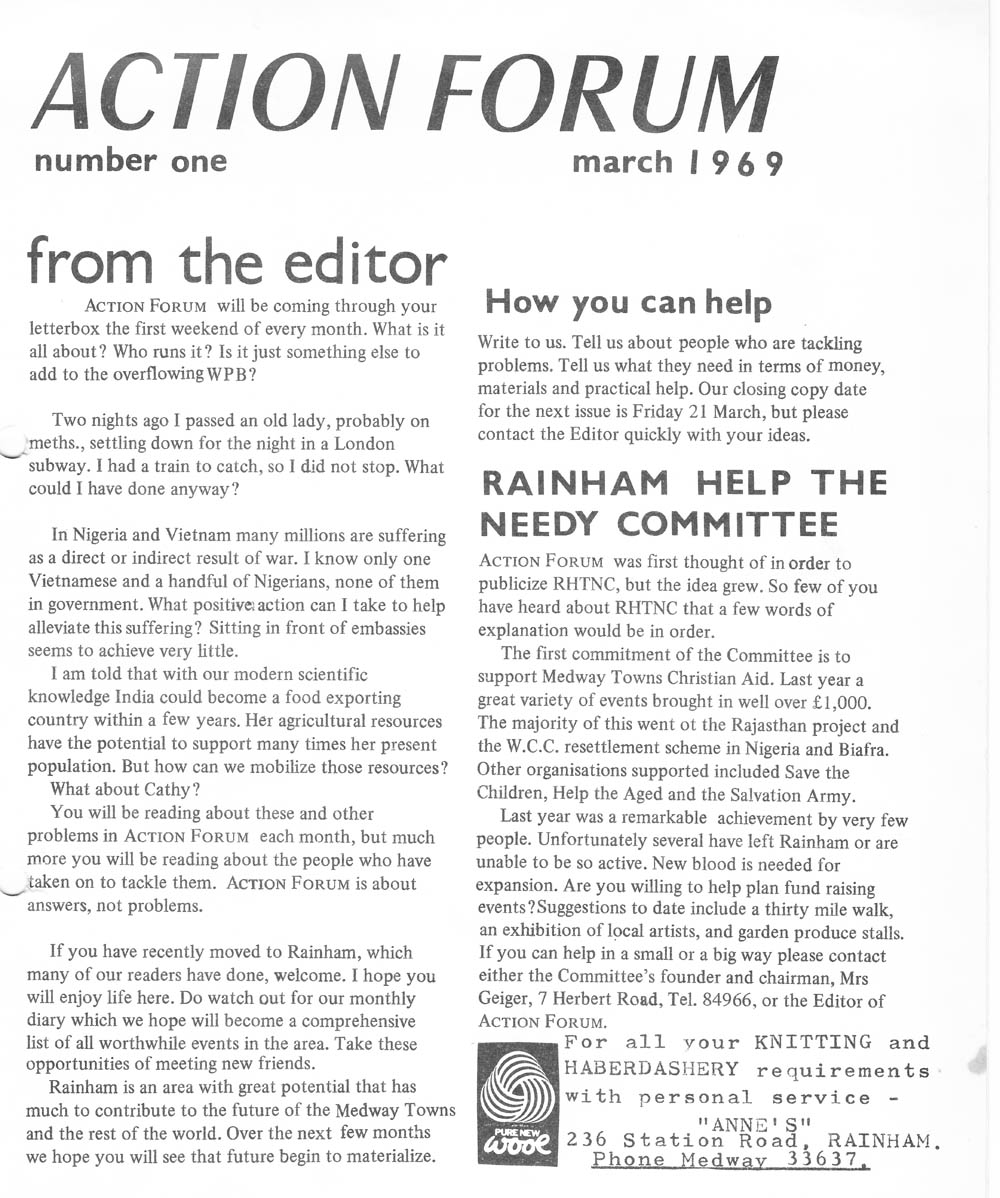
Action Forum is a free monthly magazine that is distributed to the Rainham area covering Wigmore, Parkwood and Hempstead as well. This archive covers old copies of the magazine dating back to its initial publication in 1969 and give a fascinating glimpse into life in Rainham over the last 50 years.
Link to Article Index - Action Forum Index - Photos and Articles from 1969 onwards